Raymond Saner & Ricardo Guilherme, G-24 Policy Brief Nr. 19; 1st March 2014 IMF Conditionalities for the Least Developed Countries.
This policy brief argues that, all too often, the Fund’s use of “conditionalities” for lending has stepped beyond its core legal mandate, particularly causing harm to the least developed countries’ economic development, for example by dictating their trade policies.
Raymond Saner (2024) “The WTO, Climate Change and Sustainable Development” (accepted for publication to be published as IJSD 2024 V27 N3)
The author contributes to the trade & environment debate that so far excluded theoretical concepts such as the principle of mutual supportiveness of international agreements, the insights of public goods theory, and a positive trade & environment agenda.
Based on the inclusion of these new concepts, an enlarged frame of trade, environment, and development is proposed which forms the basis for a reinterpretation of standard WTO articles making a more inclusive approach possible to stop climate change. For instance, the Local Content Requirement is discussed as a means to support citizens of developing countries to generate their renewable energy sources combined with a reinterpretation of Intellectual Property Rights to make the transfer of technology possible of renewable energy in the less developed parts of the world.
The suggested solution is a cross-régime/forum agreement to reduce climate risks by integrating trade into the 2030 Agenda and its 17 SDGs resulting in a reduction of climate warming which is much less costly than the looming future costs and liabilities caused by climate change.
Raymond Saner, Titular Professor, University of Basel, WWZ, presentation on 5th November 2021 on “Strategien und Bedeutung Internationaler Organisationen” (Strategies and Importance of International Organisations) in the context of the teaching programme on “Globalisation Talks” of Professor Rold Weder, Dean, Economic Sciences Center (WWZ), Basel
Raymond Saner and Lichia Yiu “NGO Diplomacy to monitor and influence Business and Government to tackle Work Precariousness”, 2023. This book chapter focuses on the roles that Transnational Nongovernment Organizations (TNGOs) can perform, alongside psychologists whose jobs focus on work, labor relations, poverty reduction, development, and wellbeing, to help to tackle precarious work in all of these multifaceted forms (Saner & Yiu, 2012, 2014a). The chapter is based on the experience of the Centre for Socio-Eco-Nomic Development (CSEND), a United Nations (UN)-accredited non-government organization (NGO), and its work to promote social progress around the world.
This article recounts a historical negotiation success during the Westphalia negotiations in the 17th Century. Mr. Rudolf Wettstein, the then Mayor of Basel City, was able to single-handedly obtain exemptions for the Swiss cantons from being accountable to courts of the Holy Roman Empire of German Nations (HRGE), amounting to a declaration of independence. As a first step, the author describes the historical context of the negotiations and subsequently the nego- tiation process involving multi-actor international negotiations during the peace negotiations at Westphalia which consisted of multi-actor internal negotiations within the Swiss Confederation and external multi-party negotiations with the leading powers who participated in the Westphalia negotiation process. As a second step, concepts of negotiation theory are used as an attempt to make sense of Wettstein’s negotiation approach. The article concludes with a proposition for more theory building and provides initial concepts to better capture multi-actor negotiations.
Intersection of Roles between States and Multinationals”, in H. Ruel, International Business Diplomacy (Advanced Series in Management, Vol. 18), pp 109-122, Emerald Publishing Limited, Bingley
This chapter describes and discusses the growing intersection of roles and functions between states and multinationals in the field of diplomacy and how diplomatic skills are needed to support transnational companies in their search for markets in emerging countries.
“Closing policy gaps to enable agripreneurship of smallholder farmers in developing countries”
This study investigates the broader context of smallholder farmers’ operations and provides insights into the options that smallholder farmers in poor developing countries have when engaging in agripreneurial undertakings for additional income generation. Such personal agency when effective could support them to alleviate poverty, reduce hunger, and achieve sustainable livelihood. Yet in practice, such personal efforts are often wrought with uncertain outcomes. Therefore an enabling policy environment is necessary to ensure the success of this strategic intervention in lifting and supporting sustainable livelihoods of rural farmers struggling with the precarity of their life situation.
Saner, R. ; Yiu, L., “Developing Sustainable Trans-border Regions: The Need for Business Diplomats, Entrepreneurial Politicians and Cultural Ambassadors”, in Trappe, P. Social Strategies: Monographs on Sociology and Social Policy, Vol. 30, pp 2000.
Raymond Saner and Lichia Yiu (Summary of the Research Study Report, “Closing policy gaps to enable agripreneurship of smallholder farmers in developing countries”, 2023, Saner & Yiu with Roberts, part of the Working Paper series on Development Policies, FERDI, Paris.
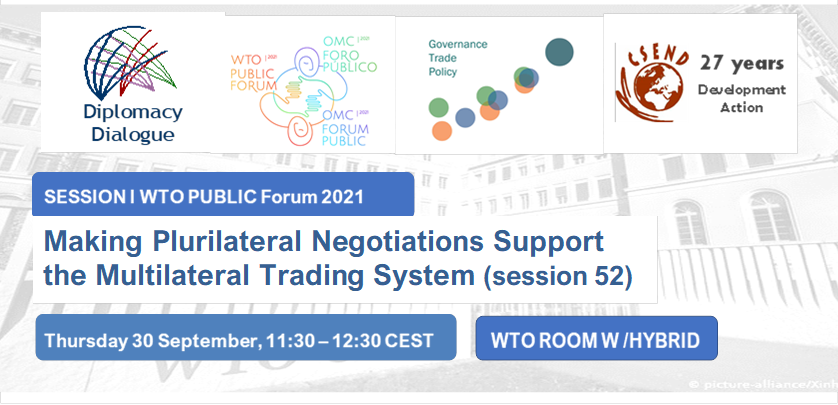
WTO Public Forum 2021, Organizer Raymond Saner, CSEND-DD, Geneva
BACKGROUND
This session focuses on the sub-theme of PF21, “Strengthening the Multilateral Trading System”. The panelists will assess how plurilateral
agreements and plurilateral initiatives could be fully mulilateralized or conclude that plurilaterals will remain outside the WTO context.
Speakers and the audience will be invited to ponder the following questions:
1. To what extent is it possible to “multilateralize” plurilateralism today (20 years into the Doha Round Negotiations with no agreement in sight
and increasing numbers of FTAs/RTAs)?
2. What are the different “options” to negotiate plurilateral agreements (with or without MFN)?
3. What are the implications of plurilateral agreements for the multilateral trading system (Leading to more integration or fragmentation of the trading system)?
4. Besides Services, Environmental Goods, Investment, could other trade areas be negotiated through plurilateral approaches? If so, which areas?
5. What are the strategies and tactics available to developing and least developed countries in the negotiation of plurilateral agreements?
SPEAKERS:
Hamid Mamdou, ret. Former Head of the Services and Investment Division at WTO, now with King & Spalding, Geneva
Stuart Harbinson, former Trade Representative of Hong Kong to WTPO, then became a senior WTO official, being Chief of Staff to DG Supachai and later Special Adviser to Pascal Lamy
Professor Peter Draper, Interim Head: School of Economics and Public Policy, Executive Director: Institute for International Trade, University of Adelaide, previously with SAIIA, South Africa
Mr. Pradeep S Mehta, Secretary General, CUTS, Jaipur, India
CHAIR
Prof. Raymond Saner, Titular, Basel University and co-founder of CSEND, Geneva